Resilience, Deterrence, and Reconstitution in Seabed Infrastructure Protection
By Tim O’Connor, Director of Advanced Technology, BlackSea Technologies
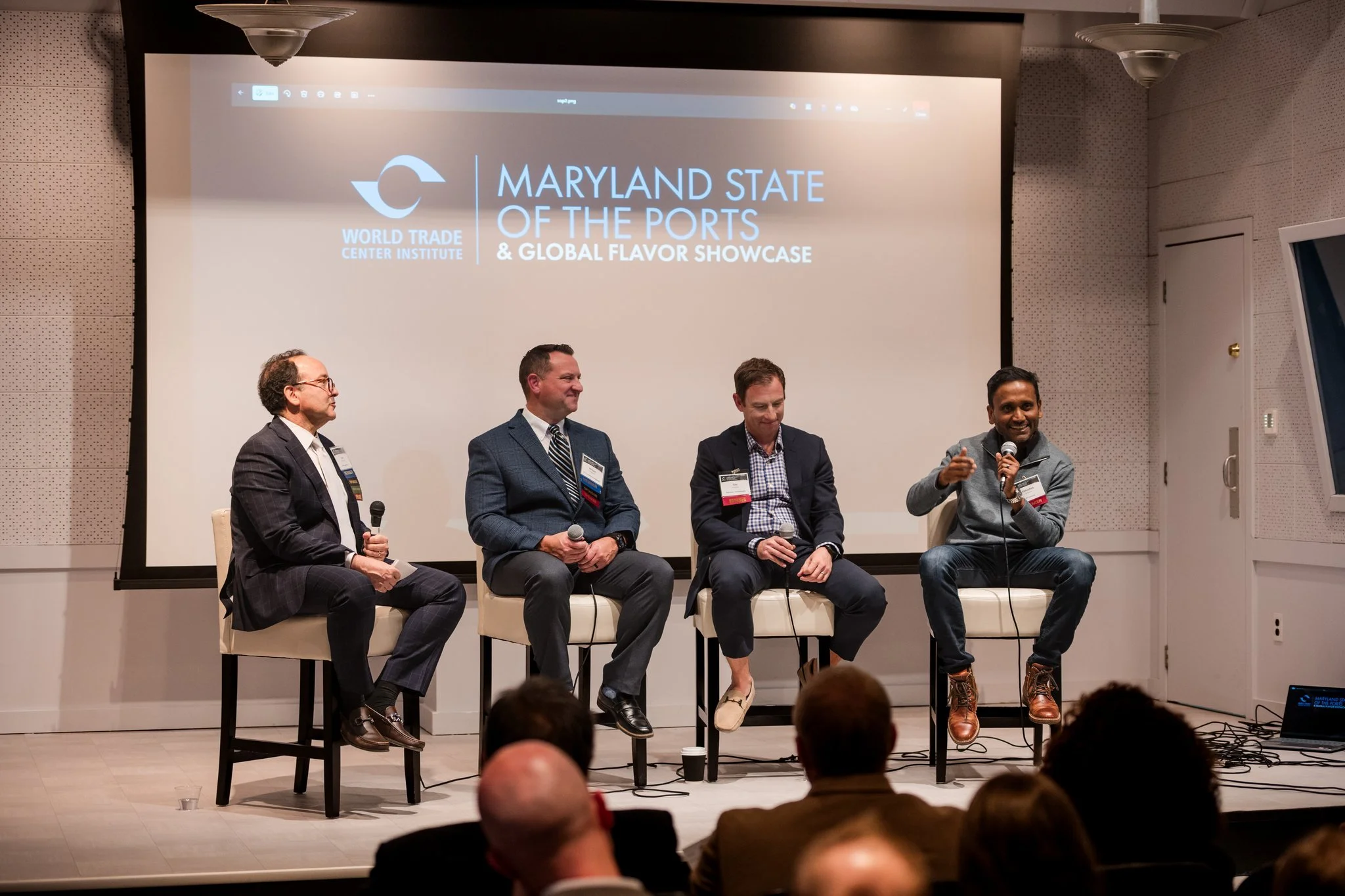
BlackSea Advanced Technologies Director Tim O’Connor, pictured one from the left, speaking at Maryland State of the Ports.
I served in the US government for about 20 years, first as a naval officer and then as a civilian, and I’ve been working on the critical infrastructure protection topic for about 16 years, first as an intelligence problem, then a strategy/policy problem, and now as a technology problem. My introduction to critical infrastructure protection was through my time working in the Office of Naval Intelligence. I had the great fortune to work with a small, but dedicated team there that performed world-class analysis to help understand the scope and the reach of the threats.
At that point, the real challenge was convincing policy makers that threats to seabed infrastructure were real. I spent a not insignificant amount of time briefing senior leaders in the Pentagon, supporting war games, and trying to draw attention to the asymmetric threat. And if I can be honest, I received more than a few indifferent responses from senior leaders. Not that I could blame them. We were in the middle of the war on terror, NATO had not dealt with a true nation-state threat in over 20 years, and the prospect of infrastructure protection seemed, well, unnecessary.
So, I’m incredibly appreciative and thankful for the fact that this issue has gained attention and traction; it desperately needs it.
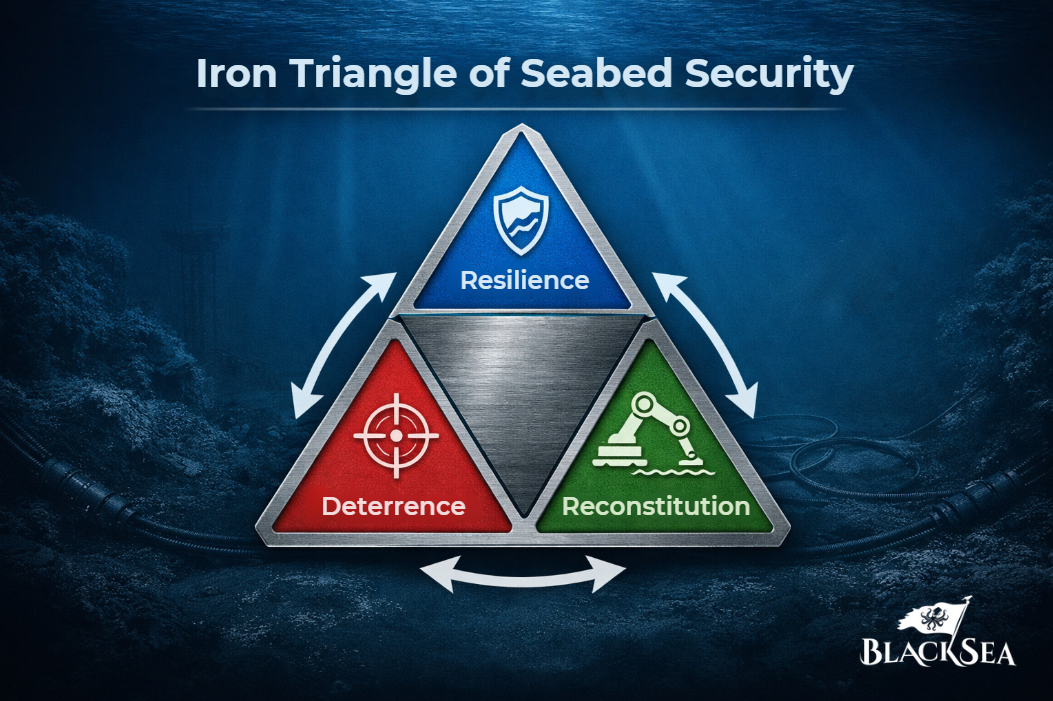
The Iron Triangle of Seabed Security
The Iron Triangle of Seabed Security
When we talk about protecting critical infrastructure, I like to think of an iron triangle for the seabed. In a technology firm like BlackSea, the iron triangle generally corresponds to achieving balance across cost, schedule, and performance to deliver an advanced autonomous system. In undersea security, the three legs of the triangle are:
Resilience
Deterrence (which I generally correlate to attribution)
Reconstitution
You need all three to achieve strategic endurance in infrastructure protection.
Resilience
I’ll start with resilience. Seafloor infrastructure is inherently vulnerable. First, it is located in the maritime commons that can be accessed by any state or actor. Second, there are relatively few actual defenses. Some cables or pipelines may be buried, but generally, we’re relying on depth of water and distance from shore as protection. Finally, even if there were no deliberate, manmade threats, there’s seafloor infrastructure that is already vulnerable enough to inadvertent and natural activity including anchor drags, earthquakes, or even fishing. I highlight these vulnerabilities because it underscores a key point – we can’t protect all of it. Our networks and infrastructure will take hits, and they must be able to continue to function thereafter. That is resilience. Now how do we build it?
If we use undersea cables as an example, we can talk about both logical and physical resilience. Logically, I want network operators and consortiums to dynamically re-route data away from threats, around faults, and onto non-traditional paths that are difficult to disrupt. In some cases, we have that – larger cable consortium generally has at least some meshed networks where they can rapidly do network layer or transport layer reprovisioning, but that process is generally opaque and limited in scale. There’s no guarantee that the most important or highest priority traffic will get through. What we need is higher level network orchestration that can operate across multiple consortium and cable systems to elevate and prioritize traffic. This is challenging because it requires potential competitors to work collaboratively together and share potentially proprietary data to ensure seamless interoperability. That’s not a small ask of industry.
On the physical level, I view resilience less about hardening of individual systems and more about route diversification and increasing the number of cable systems in the water. We’ve seen some things like this from the US government and Team Telecom, but I generally favor a different type of approach.
Installing seafloor infrastructure is a challenging, capital-intensive endeavor, and so greater government “oversight” – even if well intentioned – can actually stymie the type of behavior that you’re looking to encourage. A major transoceanic system could cost in excess of $400M to build and it would cost tens of millions to operate on an annual basis. Taking alternative routes, at new landing stations or away from traditional great circle routes would just further increase the capital cost and might deter a consortium from installing a new cable.
My belief is, and always has been, that governments are more likely to get the desired outcomes by incentivizing them, rather than mandating them. To give some examples, that could be offering tax incentives for installing new fiber paths or establishing automatic reprovisioning across a broader network. If we incentivize industry to get outcomes, vice over-regulate it, it will encourage creativity and enhance resiliency.
Deterrence
While resilience is the first step, it’s not enough, not on its own. The second leg of the triangle is deterrence, and in the case of infrastructure protection, deterrence starts with attribution.
Attribution is so important because seafloor infrastructure is uniquely vulnerable to gray zone tactics. Since the Russian invasion of Ukraine, there have been multiple incidents in which seafloor infrastructure around the Baltic was damaged by anchor drags from civilian vessels. Officials have been able to identify the vessels responsible for the damage, trace back the connections of the crew, and forensically examine their movements to try and discern intent. The work by European authorities is probably the gold standard for infrastructure protection. But this process has been slow and does not scale against a committed adversary.
The challenge has historically been that inspecting seafloor infrastructure, conducting surveys or the like, has always been dull, dirty, dangerous, and expensive. I’m likely paying for a large OSV to drag an ROV around for multiple weeks, and then taking even longer to analyze and interpret the collected data. Once complete, my survey data is now weeks old and likely does not reflect changes to the condition on the seafoor already over the subsequent weeks. I mentioned I had some history as an intelligence briefer – on more than one occasion there was some uncomfortable silence when I was asked, “what happened since this survey?”
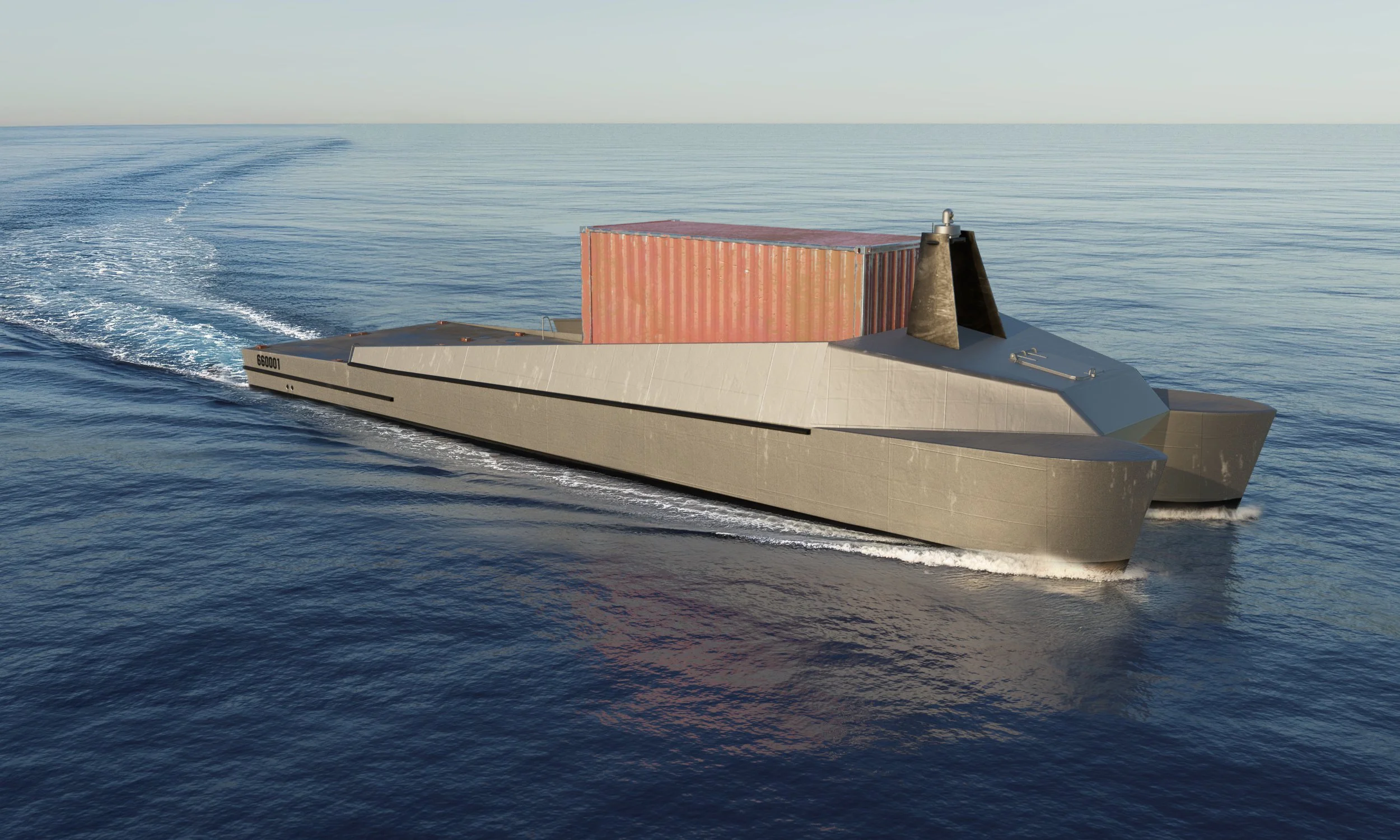
BlackSea’s Modular Attack Surface Craft
At BlackSea, we’re looking to revolutionize that through advanced autonomy and unmanned systems. Our newest unmanned surface vessel, the Modular Attack Surface Craft (MASC), was specifically envisioned to be capable of executing long-endurance, autonomous infrastructure surveys for exactly this purpose. To serve as a sentinel protecting critical infrastructure.
We designed the vessel to have a stable hull form and broad platform for hosting towfish, ROVs, or UUV launch and recovery systems. We partnered with autonomy and perception providers with specific experience executing unmanned oceanographic and seafloor survey, and we gave the platform sufficient power, communications, and onboard compute to triage the data collected in real-time and get it back to decision makers on a relevant timeline.
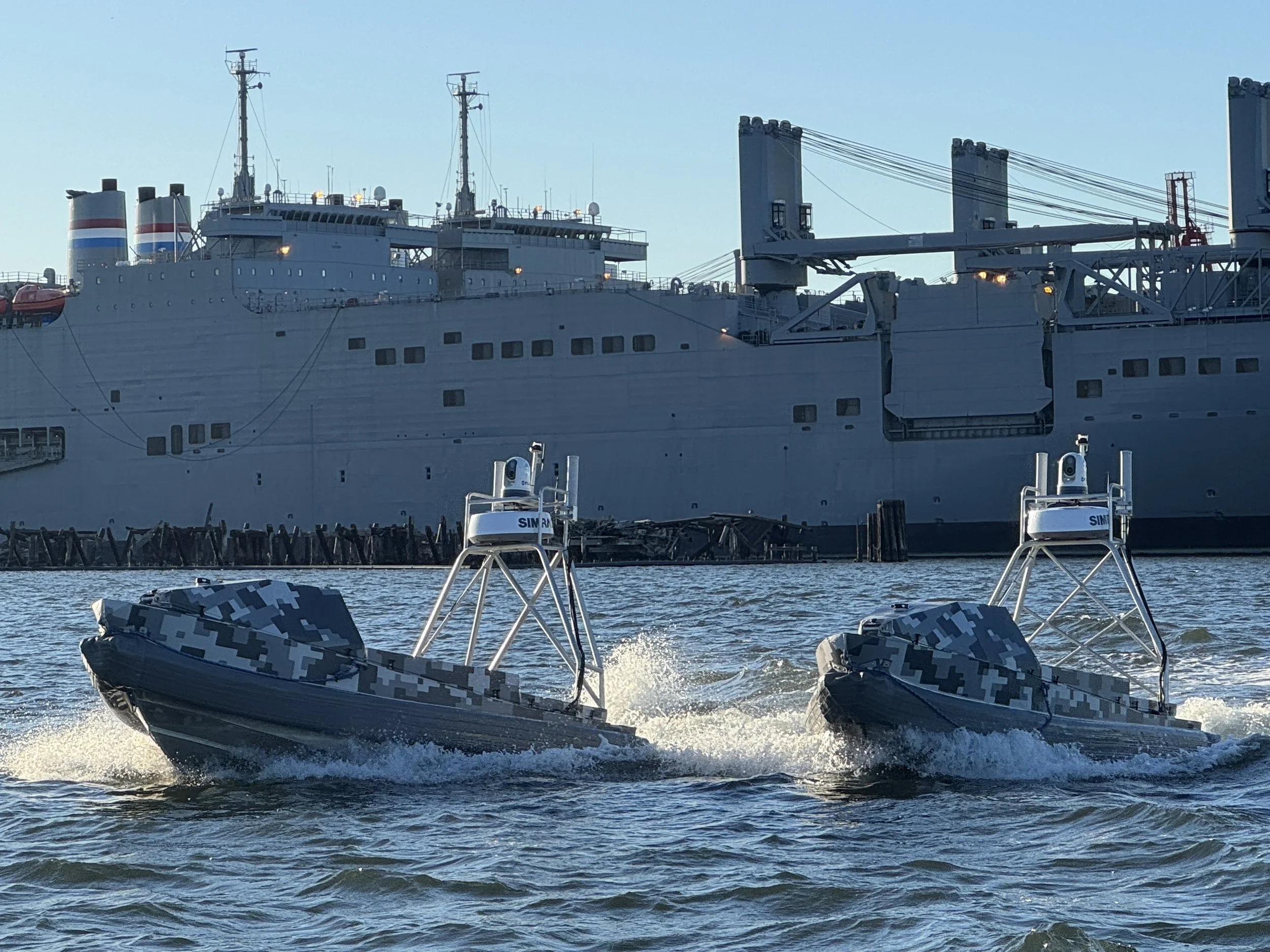
2 GARCs operating outside of BlackSea HQ in Baltimore.
Second, we had to find a way to deliver this cheaply and at scale. A boutique solution that cost the same as an OSV charter was not a significant improvement. So the construction of our MASC vessel leverages the same infrastructure we use to produce the Global Autonomous Reconnaissance Craft, a 16-foot interceptor that was built for a different mission set. But because we modularized the MASC construction, we were able to treat it like it was building about six GARCs.
The additional benefit of this approach is that I now have a seafloor survey platform that I can go put in harms way. We can produce a platform that delivers comparable capability to a small OSV, is a fraction of the price, and has no crew I’m putting at risk if the area needing inspecting is inside a contested area.
Ultimately, attribution is the currency of deterrence. If no one can see the act or prove the actor, the gray zone wins. Industry’s role is to provide the sensors, the autonomy, and the analytics that make mischief visible. Government’s role is to put in place policies and incentives that encourage industry to design for resilience from the start, rather than try to retrofit it after, and academia’s role is to develop engineers that can attack the problem from a systems level, and not just and individual component level.
Reconstitution
The third leg of the triangle is reconstitution — the ability to restore capability quickly after an incident. Reconstitution is as strategic as resilience and attribution because it changes the attacker’s calculus: if I know you can repair in days, not months, my incentive to attack falls.
I think this is arguably the most difficult of the three legs, especially in a contested environment. Without introducing any human factors, such as clashing navies, the ocean floor is probably the most difficult environment known to man — even exceeding space. The combination of crushing pressure, darkness, limited communications, and dynamic terrain makes every operation a feat of endurance and ingenuity.
That’s why we need to advance the technology base so that work traditionally executed by large, manned offshore support vessels can increasingly be handed off to unmanned systems. These vessels — the OSVs — are exceptional assets, but they are expensive, slow to mobilize, and finite. We need to reserve them for the most complex and exquisite tasks where direct human intervention is absolutely necessary — cable splicing at depth, heavy repair, and specialized salvage operations. Everything else — inspection, triage, mapping, even limited manipulation — should migrate to unmanned systems operating with higher degrees of autonomy.
At BlackSea, that’s the trajectory we’re on. Today, our unmanned surface vessel development is focused primarily on attribution — persistent patrol, data collection, and infrastructure survey to reveal what’s happening beneath the waves. But our strategic objective is to push that same architecture toward reconstitution — to enable repair and restoration at scale and at distance. We want to get to the point where unmanned surface and subsurface craft can do for infrastructure repair what our reconnaissance vessels do today for surveillance: extend reach, multiply coverage, and operate without putting people at risk.
We often describe our design philosophy this way: we’re building fleets of small, collaborative vessels that can collectively replicate the capability of a destroyer in the aggregate. The same logic applies to repair and reconstitution — developing families of USVs and UUVs that, in aggregate, can replicate many of the core functions of an OSV. One vehicle doesn’t need to be able to do everything; a coordinated team of small, specialized unmanned systems can survey, lift, position, and patch collectively. That’s how you move from exquisite, single-point assets to scalable, resilient systems-of-systems.
For government, reconstitution must be treated as a strategic capability, not just an industrial one. We treat sealift capacity, petroleum reserves, and air refueling as critical infrastructure because they are the lifelines of national power projection. The same mindset should apply here. The ability to reconstitute subsea connectivity, restore energy flow, or repair distributed sensor grids after an attack or accident is a form of strategic deterrence. It sends a clear message: “You can disrupt, but you can’t disable.”
That means investing in capacity, prepositioning, and incentives — maintaining ready stocks of cable, connectors, and repair modules, and incentivizing private entities to participate through tax credits, standby contracts, or guaranteed tasking pools. Just as we sustain a merchant marine under the Maritime Security Program, we could sustain a cadre of commercial repair and unmanned operators ready to respond under government priority in crisis.
Finally, for academia, reconstitution represents one of the most complex technological frontiers in maritime engineering. The progression we need is evolutionary: from human participation, to human supervision, and ultimately to human independence. That will require research in long-duration autonomy, AI-driven manipulation and sensing, novel undersea power systems, and robust human–machine interfaces. We need universities advancing not just autonomy algorithms, but materials that can endure years of submergence, tetherless power transfer, and adaptive mission planning for multi-vehicle coordination. In short, the next generation of engineers must be as comfortable writing autonomy code as designing pressure housings.
If resilience keeps the system standing, and attribution deters those who might attack it, then reconstitution ensures that the system — and the society it supports — can never be permanently disabled. And that, in the end, is what true strategic endurance looks like beneath the waves.