


Exploring Uncharted Seas with the GARC: Weapon of the Week
BlackSea Technologies' Global Autonomous Reconnaissance Craft (GARC) was recently spotlighted by Ryan Robertson and Brett Baker in a segment on emerging defense capabilities. The article highlights how GARC is pushing the boundaries of autonomous maritime operations with its modular design, long range, and multi-domain integration. Built for real world missions in the Indo-Pacific and beyond, GARC is already supporting USV Squadrons 3 and 7 and expanding what's possible for unmanned surface vessels.

GARC sUSV demonstrated at SOF Week 2025
The Global Autonomous Reconnaissance Craft (GARC) small, unmanned surface vehicle (sUSV) was demonstrated in the waters outside SOF Week 2025 in Tampa, Florida. During the event, the company conducted demonstrations of the sUSV on 6–8 May at Dock Space 10 and surrounding waters. The US Navy has been expanding the operation worldwide of the GARC. The approach aligns with the Navigation Plan 2024 (Project 33) and its determination to accelerate the integration of robotic and autonomous systems into the branch’s inventory up until 2027. Currently in full-rate production with the service, the platform will be deployed this year in operations and military exercises in Europe, South America, Africa and Asia, according to BlackSea Technologies, the platform’s supplier.

1st LAR tests sensing capabilities during Pacific Inferno
A U.S. Marine Corps global autonomous reconnaissance craft assigned to 1st Light Armored Reconnaissance Battalion, 1st Marine Division, maneuvers through the water during a sensing capability test during Pacific Inferno off the coast of Marine Corps Base Camp Pendleton, California, May 6, 2025. Exercises such as Pacific Inferno allow the Indo-Pacific Command Joint Force the opportunity to integrate forces from all branches and with our allies to conduct precise, lethal, and overwhelming multi-axis, multi-domain effects that demonstrate the strength and versatility of the Joint Force and our commitment to a free and open Indo-Pacific. (U.S. Marine Corps photo by Lance Cpl. Andrew Whistler).

Southern Lightning: NIWC Atlantic, NSWC Crane Advance Navy’s Unmanned Mission
In a dynamic display of joint innovation, Naval Information Warfare Center (NIWC) Atlantic concluded “Southern Lightning” on April 18—a week-long, multi-domain experimentation exercise off Sullivan’s Island, South Carolina. Partnering with Naval Surface Warfare Center Crane and U.S. Fleet Forces Command, the event tested communications architectures and unmanned systems in a littoral environment, with assets like the USS Cole and MH-60R helicopters supporting operations at sea. Designed to accelerate integration of manned-unmanned hybrid fleets, Southern Lightning is part of the broader Silent Swarm experimentation series, advancing assured communications and electromagnetic spectrum operations across air, sea, and subsurface domains. “Our Sailors and Marines will rely on these systems in future conflicts,” said Cliff Hunt, NIWC Atlantic’s senior technical manager. “This is how we make sure the architecture is ready—now.”

Unmanned Surface Vessel Squadron 7 Established!
On April 25, 2025, the U.S. Navy formally stood up Unmanned Surface Vessel Squadron (USVRON) 7 during a ceremony at Naval Base San Diego. Tasked with overseeing a growing fleet of small, uncrewed surface vessels, including the Global Autonomous Reconnaissance Craft (GARC), USVRON 7 marks a major milestone in the Navy’s push toward a hybrid maritime force. Cmdr. Matthew Martinez assumed command, underscoring the critical role of Sailors in integrating unmanned platforms into warfighting operations. “We will bring the manned-unmanned hybrid fleet to life,” said Martinez. Vice Adm. Brendan McLane emphasized the urgency of fielding robotic systems, calling them a “combat imperative” for distributed maritime operations. Reporting to Surface Development Group 1, USVRON 7 will pioneer new tactics and capabilities at the tactical edge, driven by the Navy’s newest robotics warfare specialists and supported by vessels like the GARC, built by BlackSea Technologies, to enhance lethality, flexibility, and decision speed in contested waters.

Where Robots Dare, How the Navy’s New Rating is Shaping Current and Future Ops
A Global Autonomous Reconnaissance Craft (GARC) belonging to Unmanned Surface Vessel Squadron 3 (USVRON 3) is deployed from the mission bay of Independence-variant littoral combat ship USS Cincinnati (LCS 20) during a training exercise at Naval Base San Diego, Mar. 6, 2025. (U.S. Navy photo by Mass Communication Specialist 1st Class Kelby Sanders)

American USV Builders Anticipate Mass Demand from U.S. Navy
The U.S. Navy is ramping up its focus on unmanned surface vessels (USVs), with plans to establish Unmanned Surface Vessel Squadron 7 (USVRON 7) in San Diego by mid-2025. As part of this effort, the Navy is expanding its use of the Global Autonomous Reconnaissance Craft (GARC), a 16-foot autonomous USV built by Maritime Applied Physics Corporation (MAPC). Production is set to scale up to 32 units per month, reinforcing the demand for cost-effective, high-volume unmanned systems. With its proven performance and affordability—under $1 million per vessel—GARC is a key component in the Department of Defense’s push for mass-procured autonomous capabilities. The Pentagon’s Replicator program has allocated funding for swarming unmanned systems, further highlighting the need for scalable USV solutions.
GARCs and Liberty Ships: Bellwether Defense Initiatives
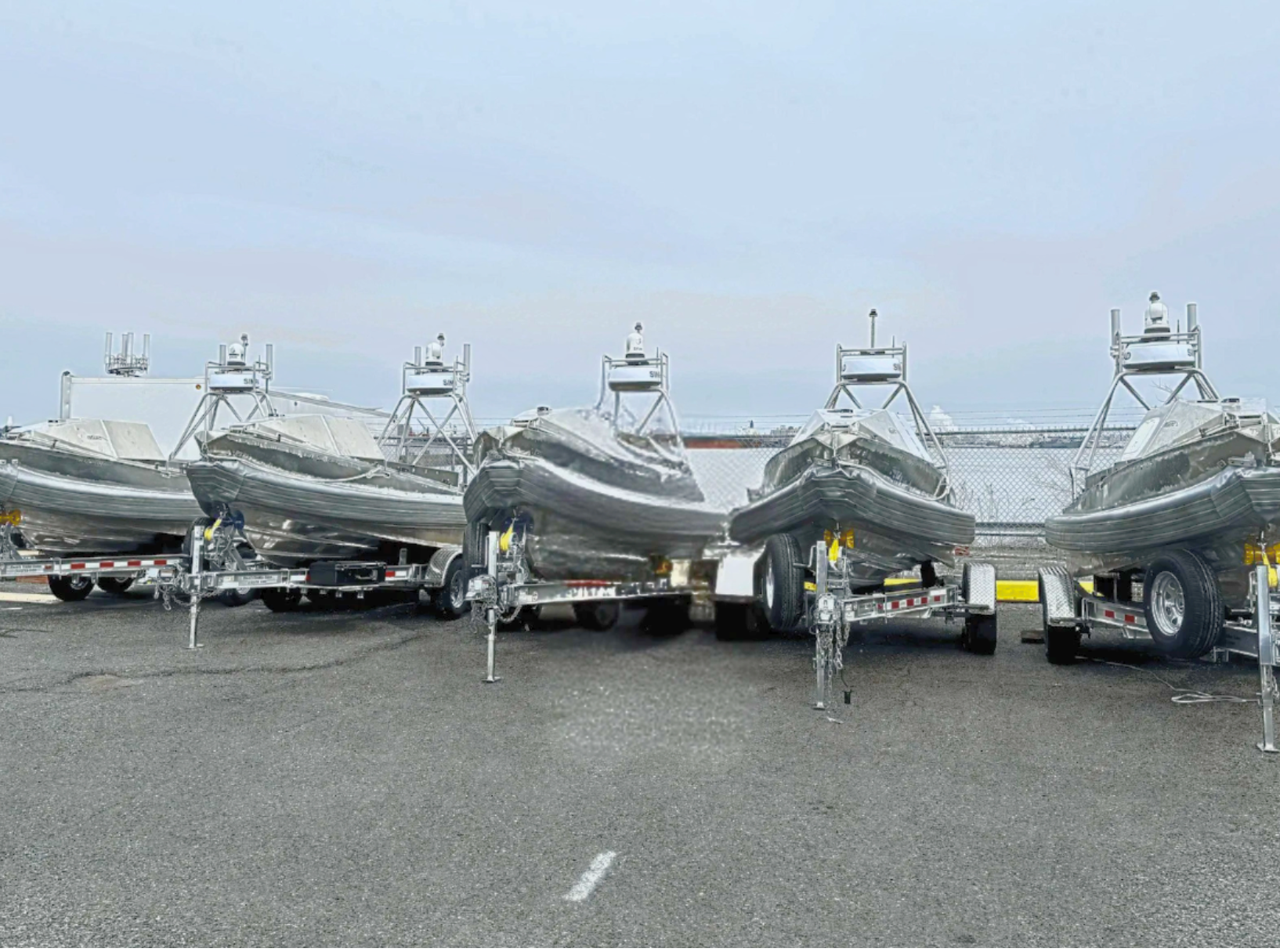
In Baltimore Harbor, a new era of naval innovation is taking shape with the assembly of the Global Autonomous Reconnaissance Craft (GARC), an advanced unmanned system designed to meet today's naval needs. Echoing the urgency and scale of America’s shipbuilding history during WWII, GARC represents a key development in the Department of Defense's push for scalable autonomous systems. As demand for these systems grows, consistent production and predictable orders are essential to maintaining readiness and ensuring a sustainable defense manufacturing future.

VIDEO: GARC Navigates in Rough Seas with Ease
Built for the storm. Designed for the fight. GARC takes on high-level sea states without breaking stride. GARC is a 16’ unmanned surface vessel (USV) currently being used by the US Navy.

The Rise of the Drone Boats
The 2002 Millennium Challenge war game exposed vulnerabilities in U.S. naval strategy when a Red Team, using asymmetric tactics, overwhelmed the superior Blue Team, sinking 19 warships in minutes. The Pentagon later constrained the exercise to force a U.S. victory, ignoring key lessons. Today, those lessons are playing out globally, as Ukraine and Houthi rebels use unmanned surface vessels (USVs) and swarm tactics to challenge more powerful navies. The U.S. Navy is now investing heavily in autonomous systems to counter emerging threats.